
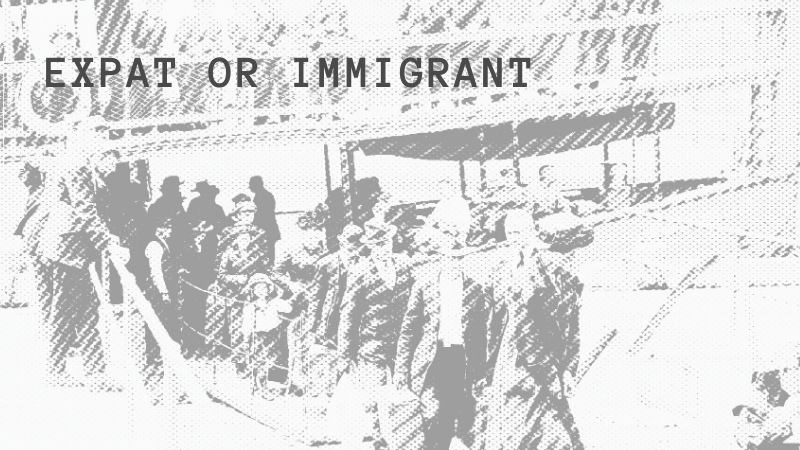
Picture this: Two people move to Germany for work. One is a British software engineer on a two-year contract. The other is a Syrian teacher planning to build a new life there permanently. Yet somehow, only one gets called an “expat” while the other is labeled an “immigrant.” What’s going on here?
It Should Be Simple: Intent Makes the Difference
The distinction between expatriate and immigrant should be straightforward: intent. Are you planning to return home eventually? You’re an expat. Are you putting down permanent roots? You’re an immigrant.
With 304 million people now living outside their birth countries, nearly 4% of the world’s population, getting these terms right actually matters (United Nations, 2024).
The Reality Check: It’s Not About Job Titles
If we applied the intent-based definition consistently, a construction worker from Guatemala on a seasonal contract would be an expat, just like the Canadian marketing manager on assignment in Tokyo. Both plan to return home; both are temporarily abroad.
Yet in common usage, the term “expat” has become an exclusive label for certain demographics. Research shows that Western professionals are far more likely to be described as expats, while people from the Global South are categorized as immigrants or migrants, regardless of their plans (Fechter & Walsh, 2010). These word choices are not neutral—they reflect deeper social hierarchies about who is seen as mobile talent and who is seen as a burden.
The Plot Twist: Status Can Change, But Privilege Doesn’t
Life rarely fits neat categories. My own journey illustrates the blur: after a decade as a permanent resident in Mexico—making me, by definition, an immigrant—I still take short-term humanitarian assignments abroad. That makes me both an immigrant in my home base and an expat in my work destinations.
But here’s the key: my European passport smooths my path in ways others don’t experience. Whether I’m labeled an immigrant or an expat, my documents open doors, my professional networks remain intact, and I navigate bureaucracy with confidence born from privilege. The terminology may shift; the structural advantages don’t.
Beyond Choice: When “Voluntary” Gets Complicated
The expat-versus-immigrant distinction also assumes freedom of choice, but the reality is more complex. Some people move abroad for adventure or career growth, while others leave because staying isn’t viable—due to war, economic necessity, or family obligations.
And language shapes how we perceive these journeys. For instance, the term “illegal immigrant” has no basis in international law, yet its use erases the human story behind movement and stigmatizes people whose situations are often anything but voluntary (De Genova, 2002).
The Bigger Picture
Words carry weight. When “expat” is reserved for white-collar professionals from wealthy countries and “immigrant” for everyone else, we reinforce a hierarchy that values some border-crossers over others.
The good news? We can do better. If we use these terms based on intent instead of prejudice, we create room for more honest conversations about the diversity of global mobility. Getting the words right isn’t just semantics. It is about dismantling the invisible hierarchies that shape how we see people on the move.
References
- De Genova, N. (2002). Migrant “illegality” and deportability in everyday life. Annual Review of Anthropology, 31(1), 419–447.
- Fechter, A.-M., & Walsh, K. (2010). Examining “expatriate” continuities: Postcolonial approaches to mobile professionals. Journal of Ethnic and Migration Studies, 36(8), 1197–1210.
- United Nations Department of Economic and Social Affairs. (2024). International Migrant Stock. UN DESA.

Leave a Reply to Patrick Crump Cancel reply