
Tag: expat life

  • The Weight of Invisible Things

    The Weight of Invisible Things

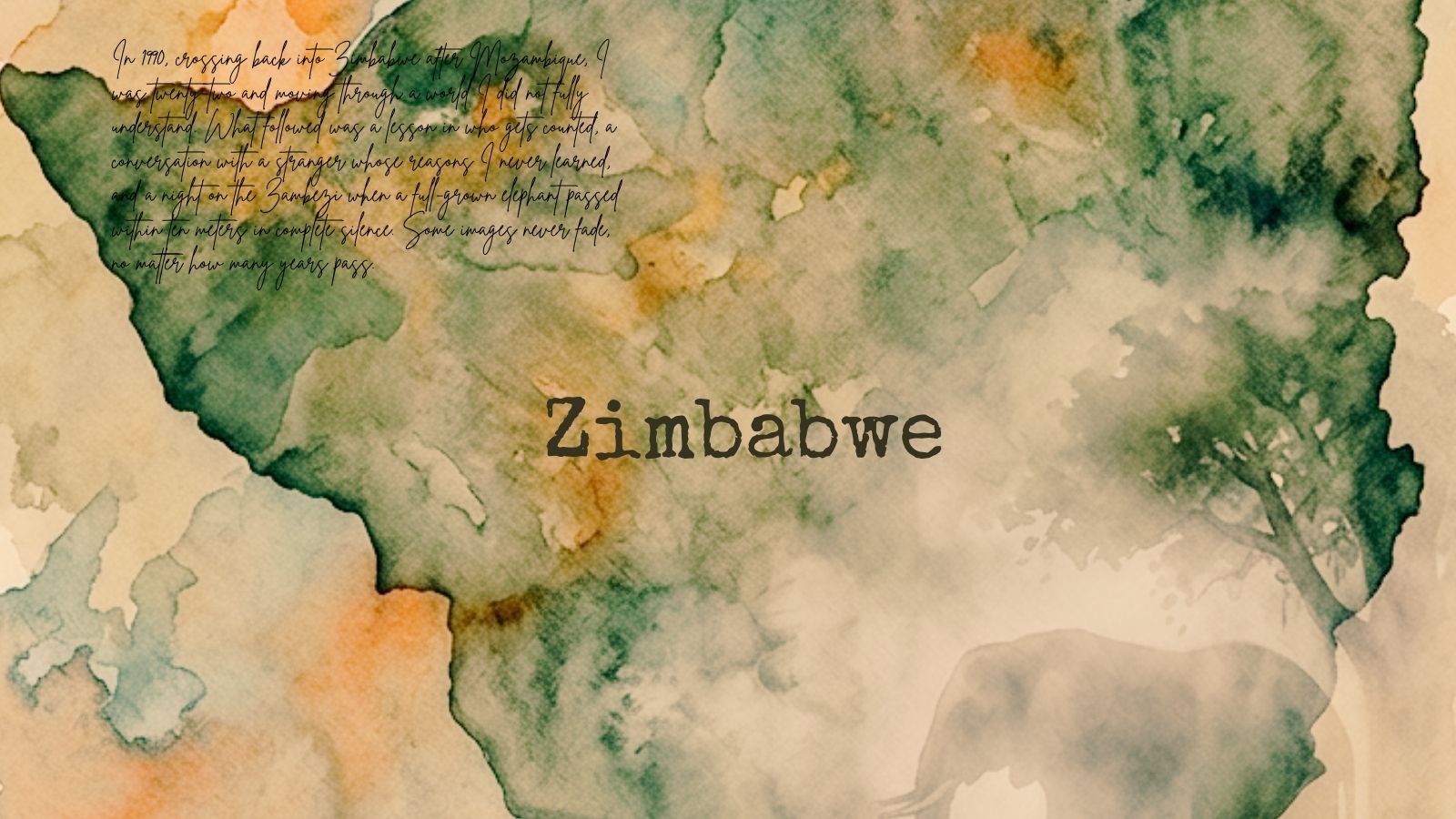
    After some time in Mozambique, crossing back into Zimbabwe felt like stepping into abundance. Markets were full, colors loud, fruit piled high in ways that felt almost theatrical after the dry austerity of the road behind me. The air carried a sense of movement, of possibility. I remember thinking that this was what relief looked like in physical form. Not dramatic, not loud. Just full tables and people going about their day.

    The Chimanimani Mountains stayed with me longer than most landscapes do. There was something deliberate about them, as if they had chosen to be there rather than simply ended up there. The light moved differently across those slopes. Mornings arrived quietly, without announcement, and the evenings seemed to fold themselves neatly into darkness.

    Advertisement

    At the hotel, I met white farmers who had left after Mugabe came to power. They told stories of departure with a strange mix of grievance and nostalgia. One of them mentioned that they had ended up in the United Arab Emirates, making moonshine of all things. That took a moment to process.

    We talked about Bulawayo. I asked how big the city was. Five thousand, one of them said casually. That puzzled me. I had imagined a place much larger.

    Oh, you mean those, he clarified when he saw my confusion.

    Those. The word hung there, stripped of decoration. It did not take long to understand that in his arithmetic, people who were not pink did not count as people at all. It was not shouted, not defended, not argued. Just stated, as if it were an obvious truth. I remember my quiet unease settling in. It became harder to relate to the stories I heard. Who was visible and who had been made invisible long before I arrived?

    Bulawayo itself faded quickly. But I met an American there whose company stayed with me. He said little about himself, and I was never quite sure what had brought him there. I did not ask. Yet somewhere in the conversation, the idea that life could unfold far outside familiar expectations began to feel less like a thought and more like a possibility.

    Advertisement

    Victoria Falls took my breath away in a way I had not thought possible. The scale refused to fit into the mind. The water did not simply fall. It roared, surged, and insisted on being noticed. Mist climbed into the sky like smoke from a fire too large to contain. Standing there felt less like sightseeing and more like witnessing something that existed entirely on its own terms.

    Later, after Kariba Lake, we took a canoe onto the Zambezi. The water moved slowly enough to feel calm, but never still. We swam in the river despite crocodiles and tiger fish, a decision that made sense only if you ignore logic and thrive on borrowed confidence. Our guide carried a calm that felt earned rather than performed. I trusted him because he moved like someone who understood the river, not someone trying to impress it.

    One night, deep in the dark, the guide woke me. Quietly, without urgency. He asked me to move a little to the side of the tree where I was sleeping. Just enough so I could see.

    On the other side stood a full-grown elephant.

    Not ten meters away. Massive. Still. And completely silent.

    I waited for the sound that should have followed something of that size. A step. A shift. The crack of a branch. But there was nothing. No vibration in the ground. No sound in the air. It did not walk so much as glide, moving slowly past the tree and into the darkness again, as if weight did not apply to it.

    Advertisement

    It stunned me more than it frightened me. Something that large should announce itself. Should demand attention. Instead, it moved as if it had no weight at all.

    One of those images that never fades, no matter how many years pass.

    I lay awake afterward, listening to the darkness settle again.

    This is the second part of a journey that began in Mozambique. The first part is here: Edges of the Journey

  • Shutdown and Sombreros

    Shutdown and Sombreros

    I’ve lived in Mexico for some years now. In that time, I’ve seen maybe three sombreros worn by actual people: on a couple of mariachi musicians, possibly one on a tourist at Cancun airport (though I can’t be certain), and that’s it. Three sombreros. Total. I probably should get out more.

    Meanwhile, despite my best efforts to confuse whatever algorithm that is feeding me, I’ve watched 20+ American politicians get digitally crowned with sombreros this past week alone. The U.S. government has shut down again, and apparently, the height of political commentary is slapping a sombrero sticker on a politician’s head and calling it done.

    I see more sombrero content from the US than I’ve seen actual sombreros here in Mexico.

    This idea led me to verify my suspicion with an AI. After some back and forth, the AI estimated that roughly 0.08% of Mexico’s population wears sombreros with any regularity (obviously, I have not found any real statistics on this). That’s mariachi musicians, charros, folklórico dancers, and a handful of tourism workers. Meanwhile, American tourists arrive in hordes (an “invasion” of over 20 million in 2023), many purchasing sombreros twice the size of their torsos, declaring themselves honorary locals after two margaritas and a mariachi selfie.

    But back to the political commentary, which apparently has reached the sticker stage. Watching these modified clips made my thoughts drift to the Mexico I know. Not out of nostalgia, but because of the absurd symmetry. While the United States is stickering its democracy, Mexico exists as a cartoon in foreign imagination. And the Mexican government isn’t exactly rushing to correct this. Stereotypes sell vacation packages.

    Advertisement

    Apart from the current misleading narrative about my home being a warzone, I believe the average American tourist views Mexico as a postcard from the 1950s: cacti, tequila, a burro resting between errands, and a man in a sombrero taking a siesta. The siesta was practical, the sombrero provided shade, and the burro was useful before pickup trucks. Practical tools became symbols of laziness. I’ve seen the same narrative in Europe about Italians and Greeks, but without the burro.

    These tourists arrive with that postcard in mind. They buy oversized sombreros, snap mariachi selfies, and go home convinced they’ve experienced “authentic Mexico.” Washington produces fake sombrero images of politicians. Cancun produces fake authentic culture for tourists. In both cases, what’s real gets edited out.

    Stereotypes are efficient “tools”. Why understand Mexico as a complex, modern country (the IMF’s 12th largest economy in the world, with tech start-ups, art collectives, environmental movements, and a dynamic cultural landscape) when a sombrero suffices? It’s the same logic behind U.S. politics: why grapple with complex policy when a ten-second clip of embarrassment will do?

    Here’s where it stops being “funny”.

    Advertisement

    When a stereotype becomes the dominant lens, it does real damage. The “lazy Mexican,” the “romantic peasant,” the “dangerous migrant.” These aren’t just wildly inaccurate and old descriptions. They shape policies and justify border walls, trade barriers, discrimination, and countless acts of condescension disguised as help.

    It is a repetitive and familiar stereotype, a fiction that becomes the accepted reality. Most Americans buying those oversized hats don’t see the harm, nor do the local traders. It’s an inherited script of a cultural default that confuses recognition with caricature. Meanwhile, the same country that turns Mexico into a costume turns its own democracy into a costume drama.

    A future historian piecing this together (the shutdowns, the edited videos, the deliberate cultural misunderstandings) might conclude that early 21st-century America was one big theme park. Every attraction is designed for maximum engagement, with minimal space for reflection.

    Most Americans are only looking for a better life, dignified and meaningful. They’re not getting it from established structures. Politics, media, corporations, and even community life have been reduced to entertainment, with real-world consequences that are anything but amusing. The spectacle continues, but the people living it must feel the fatigue.

    From here in Mexico, it’s both fascinating and absurd to observe. At least in Mexico, the sombrero still blocks the sun. In Washington, the only thing getting shaded is the truth.


    AI Transparency Statement
    AI tools (Claude/Anthropic, ChatGPT/OpenAI) assisted with drafting and editing this piece. All content has been thoroughly reviewed, edited, and verified by the author.

Privacy Overview

This website uses cookies so that we can provide you with the best user experience possible. Cookie information is stored in your browser and performs functions such as recognising you when you return to our website and helping our team to understand which sections of the website you find most interesting and useful.