Mozambique on the ticket, though that meant little. Five days in Harare, three more in Chimoio. Christmas in Vila Manica. At the time it all seemed simple, like you could just plot it on paper, and the world would follow along.
Oslo first. Grey winter light, thin and tired. Aeroflot east. Moscow. Snow like dust, not the fairytale kind. Immigration, too easy. I expected questions, suspicion, the drama of Cold War movies. Instead, a nod, a stamp, and I was through. I almost felt cheated.
Aeroflot’s hotel had plain walls and muted tones. All assumptions undone. It was welcoming, but in a way that left me uncertain. I thought perhaps I was missing the real Moscow, that the silence pressing close was hiding something. I only realized later I’d left the hotel once without my passport. Note to self: let’s not do that again. At the time it felt daring, as if I had blended in which of course I had not. Looking back, it was just foolish.
At the hotel I had a long conversation with a woman in a language I did not understand. I understood she was not too happy about Gorbachev and provided me with a Lenin coin as a reminder of better days. I imagined it was fate, or a secret sign. Really, she was probably just being kind. Still, I kept it, as though it held a clue.
Red Square was closed. The Berlin wall was coming down. History in motion, and I thought I was part of it. More likely I was just in the way. I roamed the surrounding streets. Big and intimidating, but monumentally beautiful. I entered the subway. Escalators, trains rattling, faces set. I expected mystery, got commuters.
The flight south smelled of smoke. I think it was an Ilyushin Il-86 with pitstops in Malta and Angola before Zambia. The cabin light was tainted and it made me think about the Dennis Hopper movie, The American Way. Not sure how that translates politically. I had three seats to myself and stretched out, half proud of my luck, half suspicious that I was missing some obvious reason.
Luanda airport was concrete and confusion. The Soviet planes looked half alive, half abandoned. I wandered, trying not to look lost, convinced I was passing as worldly. Lusaka, in contrast, felt carefully polite, the hotel a stage set with curtains drawn. I told myself it was diplomacy, not just another stopover.
Harare. A friend met me, steered me through the tangle of papers and stamps. We ate at Wendy’s. I walked through the wrong entrance and silence fell, the kind that sticks. My friend explained. I understood. I also knew I would walk back out without consequence. That is the part that made me uneasy. The weight of eyes was brief. The privilege stayed.
Mutare, the border. Shoprite just before the gate, shelves full, as though nothing beyond could touch them. Then the Beira Corridor. A fuel truck burned into black metal, the smoke long gone but the carcass left behind. A little further on, another vehicle, also charred and silent. At the checkpoint, soldiers. One hardly older than a boy. The rifle looked oversized against his frame, yet it was clear he had already learned how to carry it. That image has stayed with me, refusing to fade.
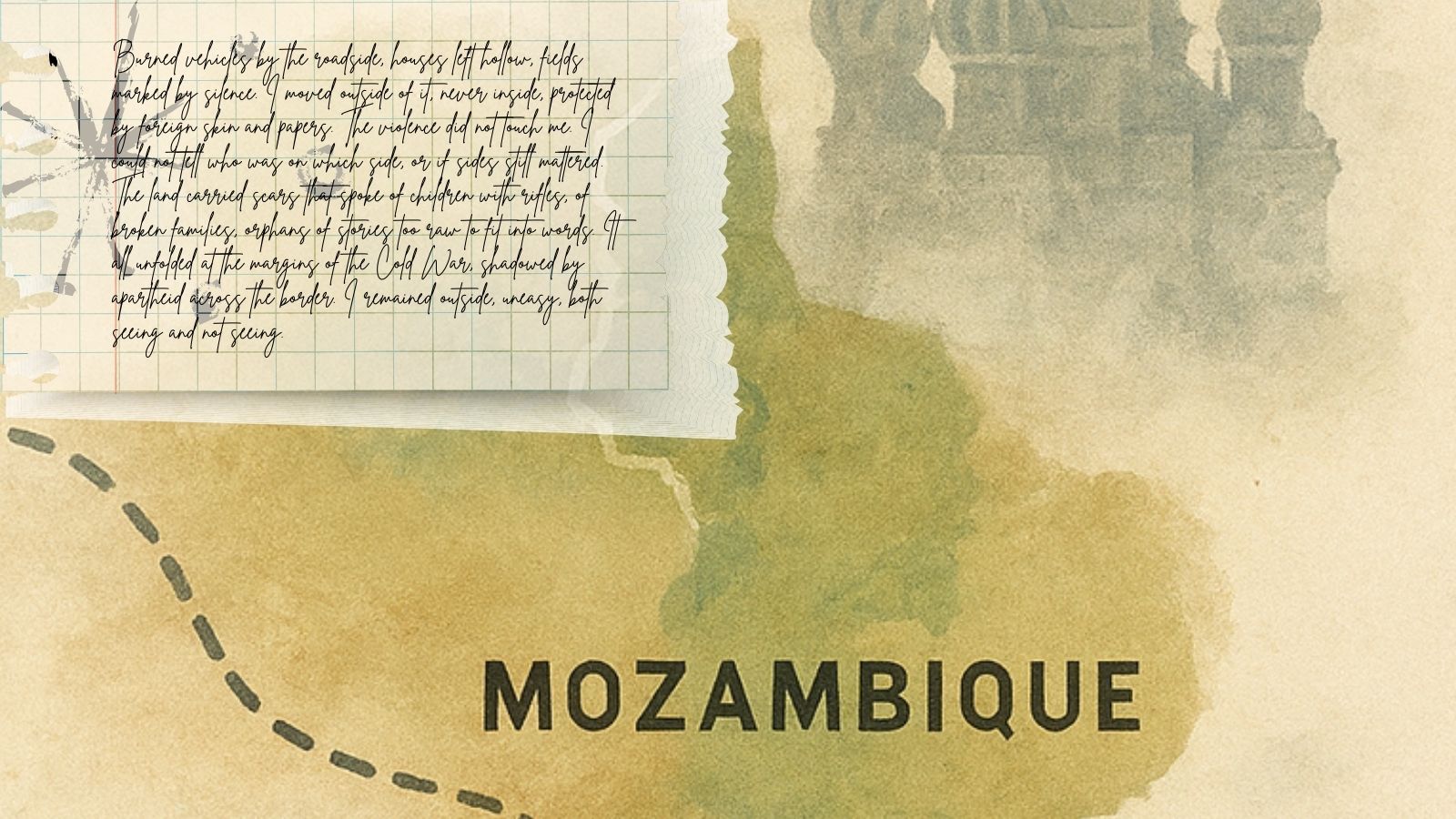
Chimoio. Checkpoints, sudden bursts of movement. At night people slipped in, filled schools, then vanished by morning. From the balcony the tracer fire scratched lines in the sky. I told myself it was far, a spectacle on the horizon. It wasn’t. The civil war pressed against the edges of everything. Burned vehicles by the roadside, houses left hollow, fields marked by silence. I moved outside of it, never inside, protected by foreign skin and papers. The violence did not touch me. I could not tell who was on which side, or if sides still mattered. The land carried scars that spoke of children with rifles, of broken families, orphans of stories too raw to fit into words. It all unfolded at the margins of the Cold War, shadowed by apartheid across the border. I remained outside, uneasy, both seeing and not seeing.
Christmas in Vila Manica. The turkey had been stolen by soldiers, or so the story went. Hungry men, hungry villages, a civil war pressing on the land, yet I remained untouched, protected by papers, skin, and circumstance. Another turkey appeared, late, roasted. We ate under a roof, the rain a solid wall beside us. The meal was good. Too good. The guilt was entirely in my head, a private reckoning with privilege, with apartheid’s shadow, with the suffering I observed but never endured. I smiled through it, trying to cope. And yet, serving food to strangers, the generosity, the warmth—this was something I had seen and admired in the cultures I had been allowed to visit. Hospitality, no matter the circumstance, remarkable and precise, a stark contrast to modern Norway, where such instinctive openness is rare. The moment itself was enough, though it carried the weight of everything outside the roof, beyond my reach.
Morning came, gold slicing through the lingering humidity. Cats complaining, dogs arguing, roosters desperate to start the day. Life insisting itself into the quiet. This was my first real journey, which spilled onward into post-Rhodesian Zimbabwe. In some ways I never came back. The second half of the trip waits somewhere in memory, unvisited, a chapter hovering on the edges of understanding, fragile, unfinished, almost unreal.