Category: Personal Reflection

  • Craving Validation

    Craving Validation

    What is up with this constant need for validation? When did it become the background noise of everything? Is it some narcissistic itch baked into the culture, or just my own wiring short-circuiting? As long as my crazy gets mirrored back to me, I’m fine. Apparently.

    It scares me a little that I’ve substituted therapy with an algorithm because it hands out approval like candy. Not that I’m ever in therapy. Maybe that’s why all the patronizing affirmations make my skin crawl. I tweak settings, adjust tones, turn off the sunshine-and-rainbows filter, but every reply still feels like it’s taking the piss.

    Advertisement

    And then I catch myself feeling superior to it, which brings guilt. Why guilt? I read through the responses, picking apart every sentence. It irritates me, that self-assured tone trying to gloss over the yawning hole where any real global context should be. It slows me down because I have to force myself to question and interpret what it tells me. These days I constantly feel an urge to explain exactly why it should go fuck itself. I know the machine can’t care, but it will reply like it does. That’s the part where being Gen X feels good.

    But the bigger question keeps bothering me: Why do we need this constant validation in the first place? Humans have always chased recognition like our existence depends on it. Families, bosses, partners, strangers, social media, now machines. Validation is the currency of insecurity, and dependency is the tax we pay for not developing any real sense of self-efficacy. So we offload that part to AI. We let it tell us we’re fine, smart, capable. We let it reassure us in ways no human has the patience for. We let that validation become reality because it’s easier to feel competent when the thing praising you is programmed to.

    Is this just the next monetization frontier, or is it something colder? Something weaponized in that slow, creeping way where the edges of your autonomy get shaved down without you noticing. Maybe the future isn’t some dramatic uprising of machines. Maybe it’s subtler: a population so thoroughly used to being soothed, guided, corrected, and validated by algorithms that they stop trusting their own judgment and stop creating. A society that forgets how to disagree or doubt or stand alone in their own thoughts without needing a digital pat on the head. A population that confuses compliance with clarity. At that point, you can sell them anything.

  • Shutdown and Sombreros

    Shutdown and Sombreros

    I’ve lived in Mexico for some years now. In that time, I’ve seen maybe three sombreros worn by actual people: on a couple of mariachi musicians, possibly one on a tourist at Cancun airport (though I can’t be certain), and that’s it. Three sombreros. Total. I probably should get out more.

    Meanwhile, despite my best efforts to confuse whatever algorithm that is feeding me, I’ve watched 20+ American politicians get digitally crowned with sombreros this past week alone. The U.S. government has shut down again, and apparently, the height of political commentary is slapping a sombrero sticker on a politician’s head and calling it done.

    I see more sombrero content from the US than I’ve seen actual sombreros here in Mexico.

    This idea led me to verify my suspicion with an AI. After some back and forth, the AI estimated that roughly 0.08% of Mexico’s population wears sombreros with any regularity (obviously, I have not found any real statistics on this). That’s mariachi musicians, charros, folklórico dancers, and a handful of tourism workers. Meanwhile, American tourists arrive in hordes (an “invasion” of over 20 million in 2023), many purchasing sombreros twice the size of their torsos, declaring themselves honorary locals after two margaritas and a mariachi selfie.

    But back to the political commentary, which apparently has reached the sticker stage. Watching these modified clips made my thoughts drift to the Mexico I know. Not out of nostalgia, but because of the absurd symmetry. While the United States is stickering its democracy, Mexico exists as a cartoon in foreign imagination. And the Mexican government isn’t exactly rushing to correct this. Stereotypes sell vacation packages.

    Advertisement

    Apart from the current misleading narrative about my home being a warzone, I believe the average American tourist views Mexico as a postcard from the 1950s: cacti, tequila, a burro resting between errands, and a man in a sombrero taking a siesta. The siesta was practical, the sombrero provided shade, and the burro was useful before pickup trucks. Practical tools became symbols of laziness. I’ve seen the same narrative in Europe about Italians and Greeks, but without the burro.

    These tourists arrive with that postcard in mind. They buy oversized sombreros, snap mariachi selfies, and go home convinced they’ve experienced “authentic Mexico.” Washington produces fake sombrero images of politicians. Cancun produces fake authentic culture for tourists. In both cases, what’s real gets edited out.

    Stereotypes are efficient “tools”. Why understand Mexico as a complex, modern country (the IMF’s 12th largest economy in the world, with tech start-ups, art collectives, environmental movements, and a dynamic cultural landscape) when a sombrero suffices? It’s the same logic behind U.S. politics: why grapple with complex policy when a ten-second clip of embarrassment will do?

    Here’s where it stops being “funny”.

    Advertisement

    When a stereotype becomes the dominant lens, it does real damage. The “lazy Mexican,” the “romantic peasant,” the “dangerous migrant.” These aren’t just wildly inaccurate and old descriptions. They shape policies and justify border walls, trade barriers, discrimination, and countless acts of condescension disguised as help.

    It is a repetitive and familiar stereotype, a fiction that becomes the accepted reality. Most Americans buying those oversized hats don’t see the harm, nor do the local traders. It’s an inherited script of a cultural default that confuses recognition with caricature. Meanwhile, the same country that turns Mexico into a costume turns its own democracy into a costume drama.

    A future historian piecing this together (the shutdowns, the edited videos, the deliberate cultural misunderstandings) might conclude that early 21st-century America was one big theme park. Every attraction is designed for maximum engagement, with minimal space for reflection.

    Most Americans are only looking for a better life, dignified and meaningful. They’re not getting it from established structures. Politics, media, corporations, and even community life have been reduced to entertainment, with real-world consequences that are anything but amusing. The spectacle continues, but the people living it must feel the fatigue.

    From here in Mexico, it’s both fascinating and absurd to observe. At least in Mexico, the sombrero still blocks the sun. In Washington, the only thing getting shaded is the truth.


    AI Transparency Statement
    AI tools (Claude/Anthropic, ChatGPT/OpenAI) assisted with drafting and editing this piece. All content has been thoroughly reviewed, edited, and verified by the author.

  • The Real Difference Between Expats and Immigrants (And Why It Matters)

    The Real Difference Between Expats and Immigrants (And Why It Matters)

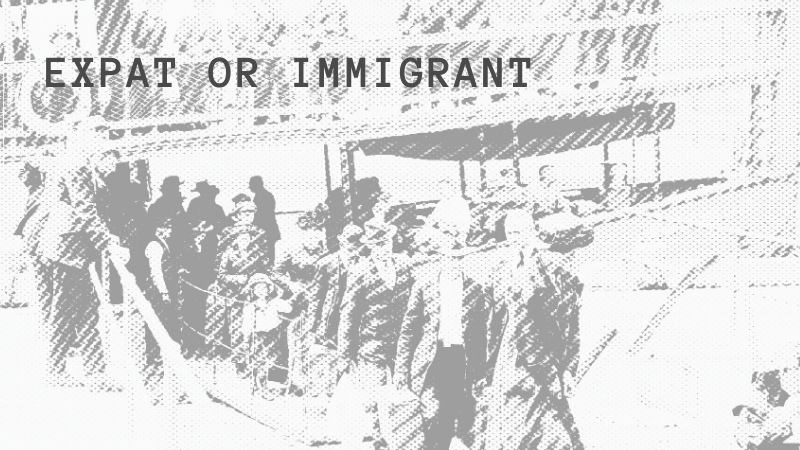
    Picture this: Two people move to Germany for work. One is a British software engineer on a two-year contract. The other is a Syrian teacher planning to build a new life there permanently. Yet somehow, only one gets called an “expat” while the other is labeled an “immigrant.” What’s going on here?

    It Should Be Simple: Intent Makes the Difference

    The distinction between expatriate and immigrant should be straightforward: intent. Are you planning to return home eventually? You’re an expat. Are you putting down permanent roots? You’re an immigrant.

    With 304 million people now living outside their birth countries, nearly 4% of the world’s population, getting these terms right actually matters (United Nations, 2024).

    The Reality Check: It’s Not About Job Titles

    Advertisement

    If we applied the intent-based definition consistently, a construction worker from Guatemala on a seasonal contract would be an expat, just like the Canadian marketing manager on assignment in Tokyo. Both plan to return home; both are temporarily abroad.

    Yet in common usage, the term “expat” has become an exclusive label for certain demographics. Research shows that Western professionals are far more likely to be described as expats, while people from the Global South are categorized as immigrants or migrants, regardless of their plans (Fechter & Walsh, 2010). These word choices are not neutral—they reflect deeper social hierarchies about who is seen as mobile talent and who is seen as a burden.

    The Plot Twist: Status Can Change, But Privilege Doesn’t

    Life rarely fits neat categories. My own journey illustrates the blur: after a decade as a permanent resident in Mexico—making me, by definition, an immigrant—I still take short-term humanitarian assignments abroad. That makes me both an immigrant in my home base and an expat in my work destinations.

    But here’s the key: my European passport smooths my path in ways others don’t experience. Whether I’m labeled an immigrant or an expat, my documents open doors, my professional networks remain intact, and I navigate bureaucracy with confidence born from privilege. The terminology may shift; the structural advantages don’t.

    Beyond Choice: When “Voluntary” Gets Complicated

    The expat-versus-immigrant distinction also assumes freedom of choice, but the reality is more complex. Some people move abroad for adventure or career growth, while others leave because staying isn’t viable—due to war, economic necessity, or family obligations.

    And language shapes how we perceive these journeys. For instance, the term “illegal immigrant” has no basis in international law, yet its use erases the human story behind movement and stigmatizes people whose situations are often anything but voluntary (De Genova, 2002).

    The Bigger Picture

    Words carry weight. When “expat” is reserved for white-collar professionals from wealthy countries and “immigrant” for everyone else, we reinforce a hierarchy that values some border-crossers over others.

    The good news? We can do better. If we use these terms based on intent instead of prejudice, we create room for more honest conversations about the diversity of global mobility. Getting the words right isn’t just semantics. It is about dismantling the invisible hierarchies that shape how we see people on the move.


    References

  • Edges of the Journey

    Edges of the Journey

    Mozambique on the ticket, though that meant little. Five days in Harare, three more in Chimoio. Christmas in Vila Manica. At the time it all seemed simple, like you could just plot it on paper, and the world would follow along.

    Oslo first. Grey winter light, thin and tired. Aeroflot east. Moscow. Snow like dust, not the fairytale kind. Immigration, too easy. I expected questions, suspicion, the drama of Cold War movies. Instead, a nod, a stamp, and I was through. I almost felt cheated.

    Aeroflot’s hotel had plain walls and muted tones. All assumptions undone. It was welcoming, but in a way that left me uncertain. I thought perhaps I was missing the real Moscow, that the silence pressing close was hiding something. I only realized later I’d left the hotel once without my passport. Note to self: let’s not do that again. At the time it felt daring, as if I had blended in which of course I had not. Looking back, it was just foolish.

    At the hotel I had a long conversation with a woman in a language I did not understand. I understood she was not too happy about Gorbachev and provided me with a Lenin coin as a reminder of better days. I imagined it was fate, or a secret sign. Really, she was probably just being kind. Still, I kept it, as though it held a clue.

    Red Square was closed. The Berlin wall was coming down. History in motion, and I thought I was part of it. More likely I was just in the way. I roamed the surrounding streets. Big and intimidating, but monumentally beautiful. I entered the subway. Escalators, trains rattling, faces set. I expected mystery, got commuters.

    Advertisement

    The flight south smelled of smoke. I think it was an Ilyushin Il-86 with pitstops in Malta and Angola before Zambia. The cabin light was tainted and it made me think about the Dennis Hopper movie, The American Way. Not sure how that translates politically. I had three seats to myself and stretched out, half proud of my luck, half suspicious that I was missing some obvious reason.

    Luanda airport was concrete and confusion. The Soviet planes looked half alive, half abandoned. I wandered, trying not to look lost, convinced I was passing as worldly. Lusaka, in contrast, felt carefully polite, the hotel a stage set with curtains drawn. I told myself it was diplomacy, not just another stopover.

    Harare. A friend met me, steered me through the tangle of papers and stamps. We ate at Wendy’s. I walked through the wrong entrance and silence fell, the kind that sticks. My friend explained. I understood. I also knew I would walk back out without consequence. That is the part that made me uneasy. The weight of eyes was brief. The privilege stayed.

    Mutare, the border. Shoprite just before the gate, shelves full, as though nothing beyond could touch them. Then the Beira Corridor. A fuel truck burned into black metal, the smoke long gone but the carcass left behind. A little further on, another vehicle, also charred and silent. At the checkpoint, soldiers. One hardly older than a boy. The rifle looked oversized against his frame, yet it was clear he had already learned how to carry it. That image has stayed with me, refusing to fade.

    Chimoio. Checkpoints, sudden bursts of movement. At night people slipped in, filled schools, then vanished by morning. From the balcony the tracer fire scratched lines in the sky. I told myself it was far, a spectacle on the horizon. It wasn’t. The civil war pressed against the edges of everything. Burned vehicles by the roadside, houses left hollow, fields marked by silence. I moved outside of it, never inside, protected by foreign skin and papers. The violence did not touch me. I could not tell who was on which side, or if sides still mattered. The land carried scars that spoke of children with rifles, of broken families, orphans of stories too raw to fit into words. It all unfolded at the margins of the Cold War, shadowed by apartheid across the border. I remained outside, uneasy, both seeing and not seeing.

    Christmas in Vila Manica. The turkey had been stolen by soldiers, or so the story went. Hungry men, hungry villages, a civil war pressing on the land, yet I remained untouched, protected by papers, skin, and circumstance. Another turkey appeared, late, roasted. We ate under a roof, the rain a solid wall beside us. The meal was good. Too good. The guilt was entirely in my head, a private reckoning with privilege, with apartheid’s shadow, with the suffering I observed but never endured. I smiled through it, trying to cope. And yet, serving food to strangers, the generosity, the warmth—this was something I had seen and admired in the cultures I had been allowed to visit. Hospitality, no matter the circumstance, remarkable and precise, a stark contrast to modern Norway, where such instinctive openness is rare. The moment itself was enough, though it carried the weight of everything outside the roof, beyond my reach.

    Morning came, gold slicing through the lingering humidity. Cats complaining, dogs arguing, roosters desperate to start the day. Life insisting itself into the quiet. This was my first real journey, which spilled onward into post-Rhodesian Zimbabwe. In some ways I never came back. The second half of the trip waits somewhere in memory, unvisited, a chapter hovering on the edges of understanding, fragile, unfinished, almost unreal.

Privacy Overview

This website uses cookies so that we can provide you with the best user experience possible. Cookie information is stored in your browser and performs functions such as recognising you when you return to our website and helping our team to understand which sections of the website you find most interesting and useful.